
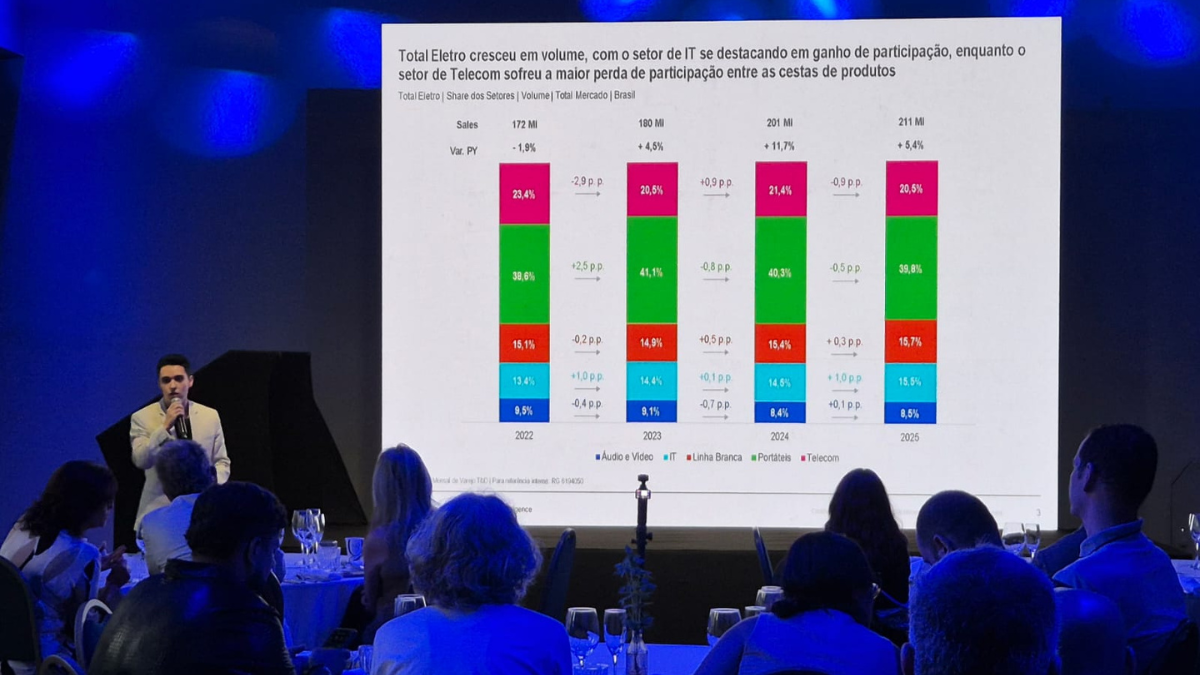
The Brazilian market for electronics and home appliances has undergone significant changes in recent years, showing consistent growth in revenue even in sectors with stable or declining unit sales. The data were presented by Mateus Bando, CSM T&D Brazil at NielsenIQ, during a press conference held by Grupo Eletrolar All Connected.
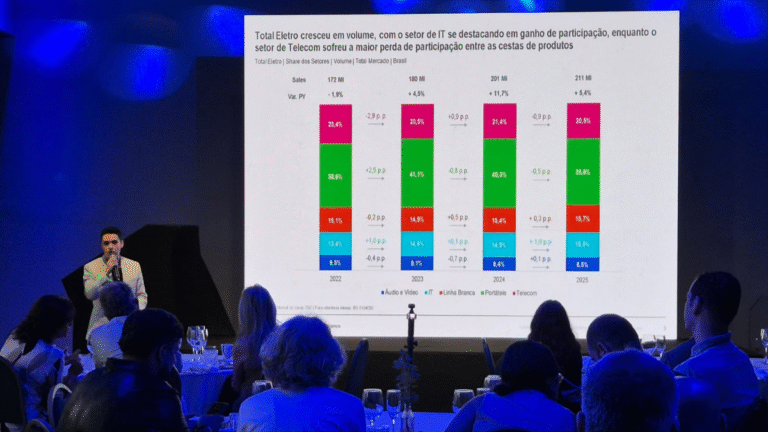
According to Bando, the IT (information technology) sector was the segment that gained the most market share in total sales, while the Telecom sector experienced the largest loss of share among the analyzed product baskets. “Total home appliances grew in volume, but the dynamics vary by category. We observe that the new reality of the Brazilian market is redefining what would be considered the retail sales benchmark,” he explained.
Smartphone penetration in the country exceeds 95%, with more than two active devices per person. This indicates that the industry is no longer growing in units but is seeing significant revenue increases, as consumers replace older devices with more modern and expensive models. “Brazilians are starting to view devices through the lens of premiumization,” Bando said, citing robotic vacuum cleaners as an example, which add higher value in the portable segment.
Between 2022 and 2025, some categories showed strong growth in sales volume: acoustic boxes and soundbars rose 74%, mini Bluetooth speakers 59%, TVs 14%, wearables 61%, keyboards 53%, tablets 45%, and headphones and headsets 43%. In white goods, highlights included refrigerators (35%), air conditioners (25%), and microwaves (25%). Among portables, sandwich makers, waffle & grills grew 57%, fans 33%, and food processors 31%.
The executive also highlighted the importance of the FIFA World Cup for the television market. Historically, TV sales rise about two months before the event and continue through the competition period. This year, growth is expected between 15% and 20%.
For comparison, in 2022, the country still had 8.7 million CRT TVs, and the World Cup accelerated the replacement with newer models, especially in the Northeast and North regions.
Bando also pointed out that categories related to information technology and computing remain in the spotlight, driven by trends such as artificial intelligence and automation. “The market transformation is evident: products with higher added value, connectivity, and advanced functionalities are gaining ground, reflecting the evolution of Brazilian consumer behavior,” he concluded.