
Ordering food has never been so simple – and so complex at the same time. Behind each snack that arrives at your home in half an hour, there is an operation moved by billions of data, thousands of couriers connected in real time and an artificial intelligence that understands the taste, the mood and even the context of who places the order. iFood, which was born in Campinas and became what can be considered one of the biggest technological “jabuticabas” in the Country, is entering a new phase: the era of AI agents. These are autonomous systems capable of making decisions in real time, optimizing routes, anticipating demands and talking with consumers on WhatsApp as if they were longtime friends. With 42% of the total team dedicated to technology and 100% of employees using artificial intelligence in the day-to-day, the company has been showing that delivery is only the tip of the iceberg of a business moved by data, machine learning and a culture that treats innovation as part of the menu.
It seems like magic, but, when you place an order, a complex world of analyses enters the scene behind the scenes. It is necessary to find the nearest courier (and available for delivery), match with the restaurant’s preparation time (so that the courier does not keep waiting), with the best route (so that the motorcycle courier can, even, deliver more than one order at a time) – all of this with the guarantee that the food will arrive hot to your home, and fast! Behind the functioning of the platform there is a system that learns and reacts in real time. Every minute, millions of information about routes, weather, menus and consumption behavior are processed to predict the flow of orders and adjust the fleet.
The invisible logic of delivery
Before the order is even born, machine learning is already working. It analyzes the history of each restaurant to adjust preparation times and calculate the ideal fleet of the day. During the process, agents monitor the couriers’ telemetry and redistribute orders according to availability. When there are unforeseen events – an absent customer or an error in the address –, the AI intervenes, solves the problem and prevents the case from reaching a human.
The result is an almost organic operation, in which data and decisions feed back into each other. “Less than 1% of deliveries face some mismatch: the person is taking a shower or informed the wrong number, etc. In these cases, the AI agent enters the scene and, in a contextual conversation, solves the problem 86% of the time. And believe it: 40% faster than a human,” explains Thiago Capeleiro, Technology director for Logistics at iFood. According to the executive, 2.1 million tickets are handled monthly by automation.
The intelligence that talks (and understands)
Soon, the public will be able to order iFood via WhatsApp, talking with an AI – called “Ailo” – that understands context. “You can say: ‘I want something light for dinner’ or ‘I want a suggestion for a romantic dinner’, and the response comes tailor-made for each customer. It also understands your habits. If you always ask to remove the spicy sauce, it already assembles the order taking that detail into consideration,” explains Isabella Piratininga, director of Disruptive Transformation of the company.
Ailo speaks by text, understands audios and learns from the history of each person, transforming the relationship with the app into something increasingly natural and human.
The brain that moves the marketplace
iFood’s intelligence is not limited to the consumer. Restaurants, couriers and internal teams also interact with their own agents. The AI agent nicknamed “James”, for example, supports the commercial team in the partner onboarding and suggests improvements in the registration to increase sales. In service, “Rosie” can solve a customer issue in 10 minutes, while the human took 38 minutes. In addition, she is 18% more empathic and already accounts for 70% of automation in service, with 83% satisfaction. She resolves cancellations, checks order status and even generates vouchers.
While agents act in digital, iFood also tests physical innovations that rethink urban logistics. The ADA robot cart, developed with the Brazilian startup Synkar, already operates in malls, transporting orders from restaurants to the pickup hubs and freeing up time for couriers. “With this technology, the courier is free to be able to execute more deliveries in less time. Already in a condominium, ADA can do the internal delivery, eliminating the need to register the motorcycle courier at the gate,” exemplifies Thiago Viana, Innovation director at iFood.
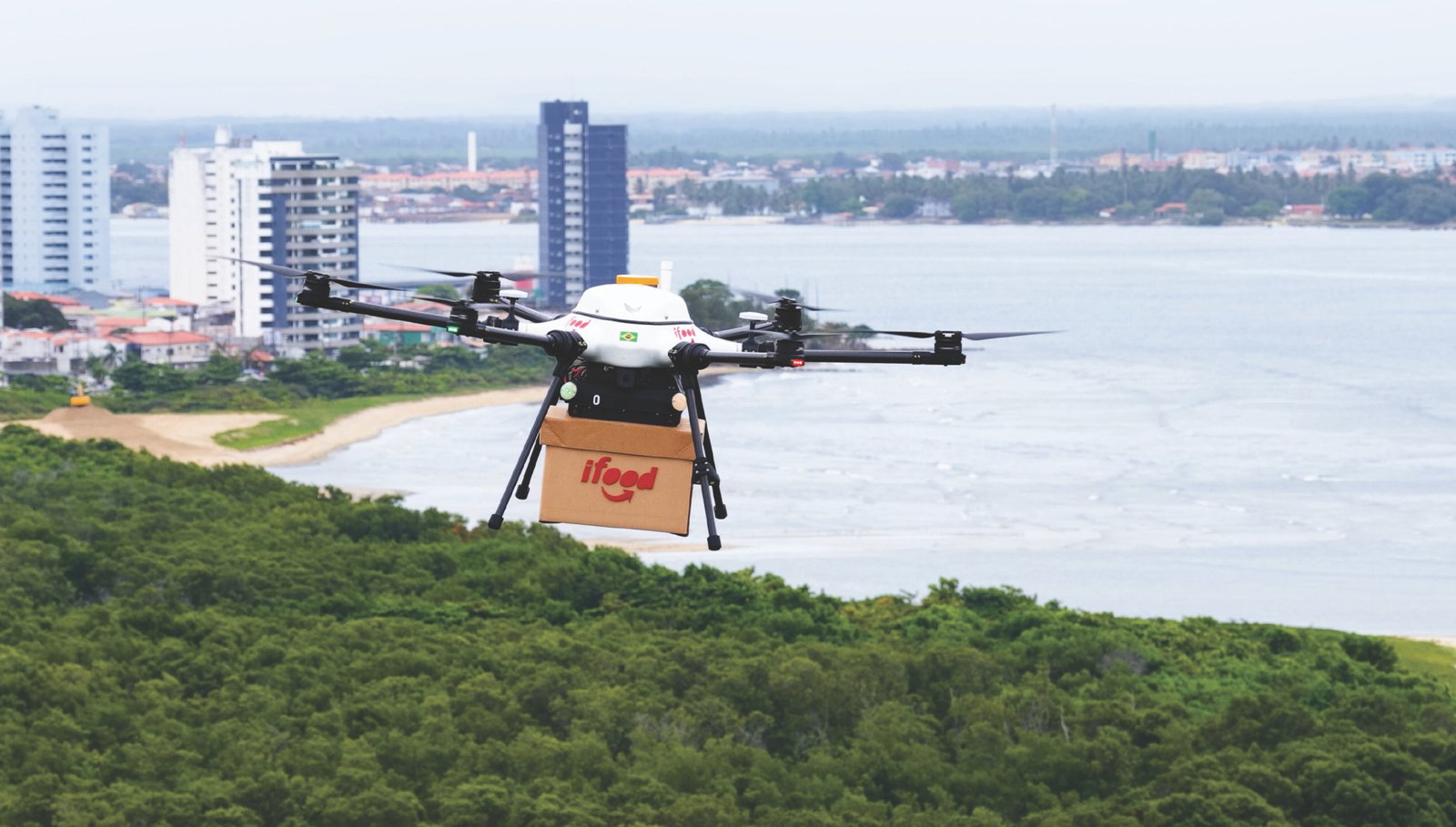
In the skies, drones cross the Sergipe river, in Aracaju, reducing deliveries of one hour – or about 18 km traveled by the courier – to 30 minutes and much less road. “Our idea is to use drones as a complement in a multimodal delivery. Just like the geography of Aracaju, in which drones cross the river decreasing delivery time, we could also think about the use of drones in places like Florianópolis, between the continent and the island. Or in Ilhabela, between the island and São Sebastião. Or even at the top of Cantareira, in São Paulo, where deliveries are scarce, even with restaurants close to the customer. The main point is to guarantee accessibility, or offer more options for our customer,” completes Thiago Viana.
When AI becomes culture
The technological advance only makes sense because it was incorporated into the company’s culture. “Today, 100% of iFood employees are encouraged to use AI in the day-to-day, and half of the budget made available for individual development (a benefit given to employees) needs to be directed to training in this topic. Once a month, the operation stops, and the teams are invited to learn to build and test new agents,” explains Raphael Bozza, vice president of People at iFood.